


Searching for contentment
In the fragrance of freshly worked wood⩘
The soft glow cast by shoji lamps⩘
The inspiration of good reads⩘
My heart is with the people of Ukraine

#StandWithUkraine
My contemplations about Ukraine⩘
Broken heart: Palestine, Gaza, the West Bank, Israel⩘
Abolish ICE! Restore Sanity!
When a pattern of human rights violations is so undeniably occurring and completely embedded within an institution, for decades, and with pervasive impunity, the only solution is to start over.… It has become clear that no amount of defunding, training or disciplinary measures will be enough. The extent and scale of the abuses and failures we documented lead to only one possible road to justice: ICE must be abolished.
– Opinion: It's time to abolish ICE⩘ by Amy Fischer, director of refugee and migrant rights at Amnesty International USA, The Guardian, Oct 5, 2026.
Living in the Rockies
Autumn is here. The leaves are changing colors and dropping. The temperature is finally cooling down. I love this time of year. While I miss the beautiful green crowns of the trees after the leaves have fallen, I also appreciate that I can see vistas that were once a bit obscured by the leaves. This is a favorite bluff along the way of my daily walk that I can now see clearly. I love the gentle colors of its rock face and the contrasting deep greens of the Ponderosa trees on its crown. I also appreciated the gentle blue sky above with its wispy waves of clouds.
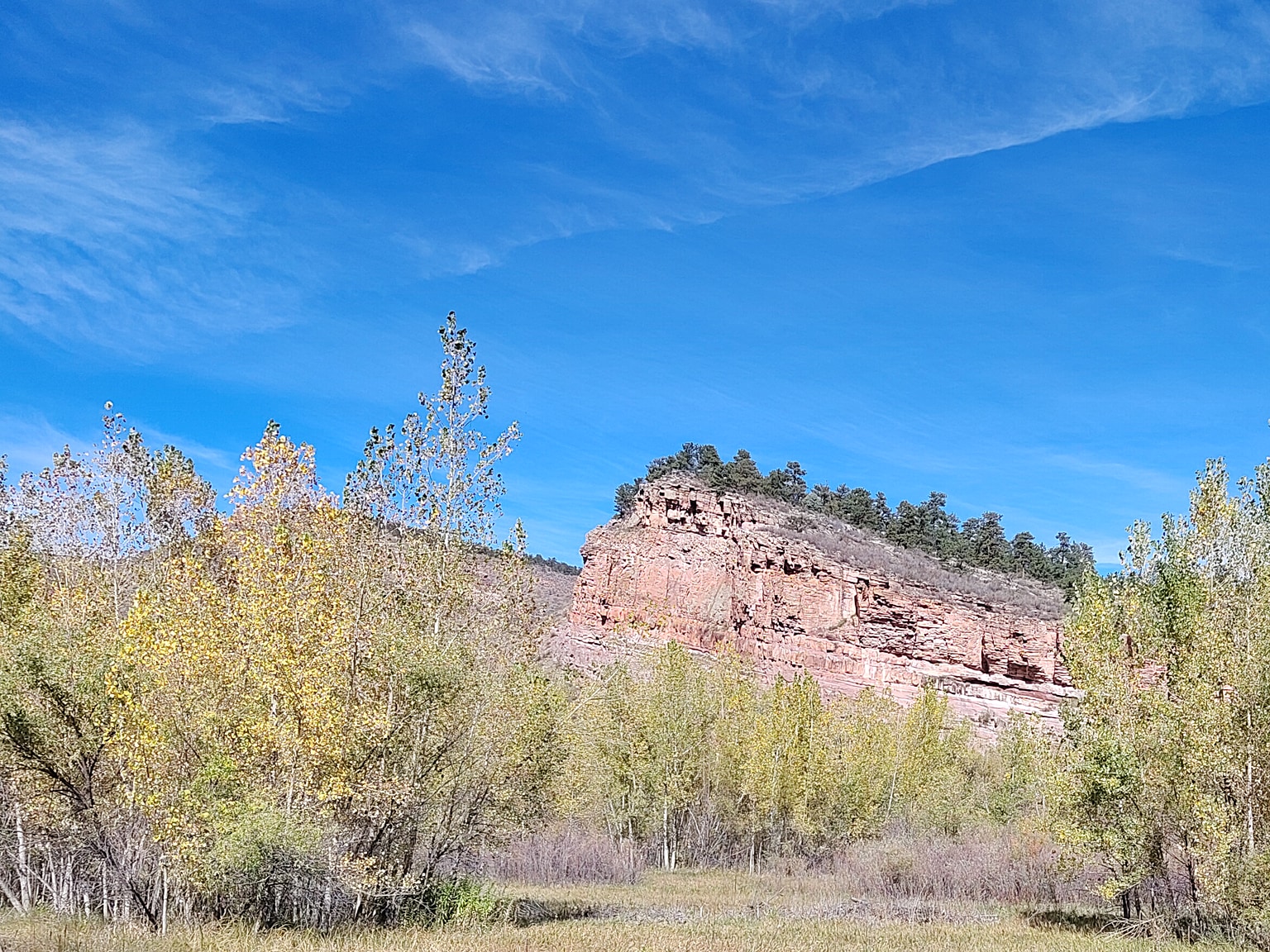
Larger version of this photo⩘
More recent photos⩘
Reading
Eric C. So, The Collision: What AI Does to Us
 Well narrated by the author
Some of the best thinking about using AI that I've come across.
I personally don't like AI and avoid it as much as I am able to, but there's no denying that the technology of AI is here and is being broadly adopted. From my simplistic perspective, the most important question to weigh is whether our civilization uses AI to benefit humanity or whether we are used and/or exploited by AI and those who control it.
Professor So deeply explores how humanity can use this technology beneficially, as well as the many ways it can be used to the detriment of those actually using it. For example, in one chapter he discusses "four rules, or principles if you will, to help navigate this new and evolving AI landscape. These aren't new ideas, exactly. They're evolved versions of the wisdom Walter Camp applied when machines first threatened to replace human muscle. Where Camp fought to preserve our physical abilities in the industrial age, these rules help us preserve cognitive abilities in the intelligence age. They're about using AI deliberately, as an amplifier rather than a replacement." Here are the four rules with excerpts:
- Value the struggle.
The first rule, valuing the struggle, asks you to see difficulty differently. AI can help you, certainly, at least in the short run. But your capacity to think independently and develop genuine mastery depends on deliberately wrestling with hard problems in a world that increasingly tempts you with effortless, AI-delivered answers. - Value who you are without AI.
The march of technology will inevitably render some skills obsolete. That is the nature of change. Our challenge is to be deliberate about which skills define our core cognitive strengths and to cultivate them, even when easier paths beckon. - Reinvest your surplus.
AI gives you something back: time, mental bandwidth, cognitive capacity. The question becomes what you do with it. - Make AI your cognitive trainer.
The fourth and final rule asks you to think of AI differently. We often approach artificial intelligence as an answer engine, a shortcut, a way to avoid thinking. But one of AI's most transformative uses is as a cognitive coach, pushing us toward questions we wouldn't have thought to ask and understanding we couldn't have reached alone.
While I realize that the author's focus was on the use of AI, I have to admit that I was disappointed that he didn't have anything at all to say about the environmental costs associated with AI use. How can you truly judge the value of using this technology without weighing those fundamental costs? Here are two related articles I came across just this morning:
- 'Pure arrogance': anger in Finland as Google illegally fells 250,000 trees for datacentre⩘ by Miranda Bryant in Muhos and Otanmáki, The Guardian, Oct 22, 2026.
- Experts warn that growing AI use adds to rising energy demand and water strain from data centers⩘ , Milwaukee Independent, Oct 21, 2026.
Eric So is a Distinguished Professor of Global Economics and Behavioral Science at the MIT Sloan School of Management.
Author's website: Eric So⩘
W. W. Norton & Co, 2026; Bookshop.org⩘ ; audiobook: Tantor Media, 2026; Libro.fm⩘ .
See also: Why I dislike artificial intelligence⩘
More recent reading⩘
Contemplating
The Lion's Head Nebula

I don't like many of the images produced to the James Webb Space Telescope, mainly because of lot of them are, I think, in the infrared spectrum, so everything looks reddish. I much prefer the visible-light images produced by the Hubble telescope. But I really like this one (I've cropped it a bit to focus on the nebula). To me, it looks like a rough-cut diamond floating in deep space.
From a NASA explanation⩘ of the image:
At first glance the nebula's overall structure in Webb's infrared images, with both the NIRCam (Near Infrared Camera) and MIRI (Mid Infrared Instrument) instruments, may look quite similar to Hubble's earlier visible-light view. However, Webb's infrared vision highlights features like compact clumps of dust and a haze of ionized gas.
What an amazing universe we live in.
Astronomy Picture of the Day, Aug 26, 2026⩘ .
More recent contemplations⩘
Fighting for American democracy
We must use our time and our space
on this little planet that we call Earth
to make a lasting contribution,
to leave it a little better than we found it,
and now that need is greater than ever before.– John Lewis, 2020
———
"If to belive in freedom and equality is to be a radical,
then I am a radical."– Patsy Mink, the first Woman of Color and first Asian-American woman elected to Congress, served in the United States House of Representatives from the state of Hawaii, 1965 - 1977 and 1990 - 2002.
———
"So what do those of us who love American democracy do? Make noise. Take up oxygen…. Defend what is great about this nation: its people, and their willingness to innovate, work, and protect each other. Making America great has never been about hatred or destruction or the aggregation of wealth at the very top; it has always been about building good lives for everyone on the principle of self-determination. While we have never been perfect, our democracy is a far better option than the autocratic oligarchy Trump is imposing on us."…
I write these letters because I love America. I am staunchly committed to the principle of human self-determination for people of all races, genders, abilities, and ethnicities: the idea that we all have the right to work to become whatever we wish. I believe that American democracy has the potential to be the form of government that comes closest to bringing that principle to reality. And I know that achieving that equality depends on a government shaped by fact-based debate rather than by extremist ideology and false narratives.
– Professor Heather Cox Richardson, Letters from an American⩘ , Sep 15, 2025.
———
Swearing an oath to our constitution
 United States Constitution with its preamble "We the People"
Government of the United States of America
Photo⩘ by Joseph Sohm⩘ ; licensed via Shutterstock
I admire the leadership of retired Maj Gen Paul Eaton who is speaking up in defense of our constitution and against the ongoing effort to politicize our armed forces.
Maj Gen Paul Eaton has sounded the alarm, saying in an interview with the Guardian that the effort to bend the higher echelons of the military to the US president's will was unparalleled in recent history and could have long-term dire consequences. He warned that both the reputation and efficiency of the world's most powerful fighting force was in the balance.
"There is an active effort to politicise the armed forces," Eaton said. "Once you infect the body, the cure may be very difficult and painful for presidents downstream."
I'm hoping that many people, both military and civilians, listen to his message.
Trump push to politicize US military 'reminiscent of Stalin', top general warns⩘ by Ed Pilkington, The Guardian, Jan 5, 2025.
More recent contemplations⩘
Woodworking
A note about the image at the top of this page

The Windtraveler—a shoji lamp I created in the shape of a deltoidal hexecontahedron—is made of 60 deltoid-shaped faces (like kites) framed in maple. Each five deltoids meeting at the more pointed bottom tips form a pentagon, creating a total of 12 pentagons, which is a dodecahedron. Each three deltoids meeting at the broader top tips form a triangle, creating a total of 20 triangles, which is an icosahedron. Within each deltoid frame are thinner 1/4 inch inner frames made of mahogany, with additional strips that run from the top tip to the bottom tip of each deltoid forming 120 right angle triangles, which reveal a hexakis icosahedron. The inner mahogany frames are backed by washi, a traditional Japanese paper, which creates a gentle shade for the light cast by the light bulbs within to pass through.
More about this project⩘
More woodworking⩘
My journey

Love nature. As a kid, I just wanted to be out playing in the woods that surrounded our small town home. When younger, I lived a few places around the world and visited several others … then found a place in the foothills of the Rockies and my heart was home. When I'm out walking, I snap photos and post the better ones on this site to preserve the opportunity to revisit some of these exquisite experiences. Photos⩘
Love reading. Growing up, I carried armloads of books home each week from the library. Now tend to carry around a virtual stack of audiobooks. I deeply appreciate authors, narrators, and translators. Since 1999, I've been posting reviews on this site, in the more recent years focused on just those books I appreciate the most. I listen to or read a lot of genres, fiction and nonfiction, and particularly appreciate well done speculative fiction. Reading⩘
Love woodworking. A passionate amateur, I revere wood. My main focus has been shoji lamps in the shape of polyhedra. I love the light that glows through washi and deeply appreciate the folks who make these papers. I'm entranced by the dance of polyhedra patterns, and keep notes on my website about the experience of making some of the lamps. I've also made a fair bit of our furniture, and have done some woodworking to fix up our old home. Woodworking⩘
Love our beautiful, fragile planet. I'm deeply concerned about our climate and all the life we are carelessly and rapidly degrading and destroying.

Photo credit: NASA/NOAA/GSFC/Suomi NPP/VIIRS/Norman Kuring
Awed by space and astronomy. Photos of spiral galaxies melt my heart and also inspire me to wonder whether I'm originally from another planet in another galaxy far far away. See also: Our home in this wondrous universe⩘

Photo credit: NASA/JPL-Caltech
Value privacy. I think online privacy should be the default state. Because it's not, I try to protect at least some of my privacy online, especially against greedy corporations.
See also:
Why I dislike artificial intelligence⩘
Privacy Is Power by Carissa Véliz⩘
Keystones: Respect, compassion, empathy, acceptance. We're all in this together.


